

Surviving the K Marathon!
K is the longest-running tradeshow show in our industry; eight days! While this provides ample networking opportunities, the long days merged with late nights of dining and entertaining colleagues, suppliers, vendors, customers and others can quickly take its toll. By the end of day three you may be asking, “How in the world am I going to survive five more days of this?”
Never fear! Our K fair veterans have compiled a list to help you survive the K fair marathon and get across the finish line in good shape.
1. Treat yourself to some relaxation. Did you know K2019 offers shiatsu, acupressure and massage? For more information, visit here.
2. Take a night or two off! While it’s tempting to participate in something every evening, we recommend taking a few nights off to catch up on some extra z’s (sleep). Your body and mind will thank you.
3. Be nice to your feet. We recommend shoe inserts and foot powder! (Shaq likes Gold Bond.) DO NOT under any circumstances save new shoes for the exhibition. Blister city! You should be breaking in a new pair of shoes (or two pairs) now.
4. Bring a spare belt. Be warned…eating good food, including many Schweinshaxe at the Zum Schiffchen expands your stomach. Two to three inches have been recorded in the first three days! At past exhibitions, the “belt repair clinic” has been a hotbed of activity for repairing buckles and adding belt holes. A larger belt is a good fallback.
5. Carry a sewing kit. As with an expanding waist, shirt buttons may begin to pop! A sewing kit with spare buttons is cheap insurance.
6. Pack supplemental vitamins. Boost your immunity with vitamins C, B6 and E.
7. Hand sanitizer. Need we say more?
8. Include face cloths for showering. Most hotels in Germany do NOT supply these and they are nice to have after a long day.
9. BEWARE: injection molding samples. You will be tempted by Darth Vader masks, plastic chair parts, and others partly or fully built home components. Just remember, you will be carrying these around in crowded halls along with bags of literature weighing as much as a small elephant. Then, you’ll have to buy another suitcase to take them home. We suggest traveling light and avoiding the cool samples.
10. Walk to the show. If the weather is nice and your hotel is close, take the opportunity to walk to the show. It’s good exercise, clears your head from the night before, and gives you time to prepare for the daily grind.
11. SECURE YOUR PASSPORT AT ALL TIMES. A replacement passport will take at least one full day, discussions with multiple people, and give you one heck of a headache. Knowing where your passport is at all times is essential! Just in case:
-
-
- Have a copy of your passport ID page in your bag/briefcase which helps with the lost/stolen process and still presents a form of ID.
- Snap a photo of your passport on your phone.
- Report stolen passports to local police.
- Report misplaced passports to your embassy or consulate.
-
12. Be aware of your surroundings. Crowded venues and public transport are prime areas for pick-pocketing and credit card scanner theft. Also, never travel alone if you don’t have to. “Buddy-up” as we say to our kids.
13. Carry some Euro coins. Take care of the restroom attendee.
14. See the sights! Hofgarten Park is recommended for a quick run or walk through the upscale Königsalle for some window shopping. The Hafen Harbor District has some good and modern restaurants. The walk along the Rhine from the show to Altstadt makes that first beer all the more worthwhile!
15. Enjoy German beverages. You must drink Killepitsch while in Dusseldorf (a local herbal liquor). The local beer in Dusseldorf is Alt. It would be blasphemous to order a Kolsch (the beer from Cologne; neighboring and rival city). But if your hotel is in Cologne, don’t dare order an Alt. It gets complicated…
16. Be prepared for the weather. Mid-October in Germany can deliver the unexpected, so pack accordingly. Most veterans ponder whether to bring the umbrella or not on a daily basis. If you don’t like getting wet, bring the umbrella.
17. Don’t forget your favorite pain reliever. Advil® and Tylenol® work well.
18. When in doubt, ask a Veteran.
#welovethekfair
If you have survivor tips not mentioned here, comment below, we’d love to hear from you!
Any questions, e-mail marketing at marketing@davis-standard.com.
Cheers,
The D-S Connect Blog Team & K Fair Veterans
10 Things to Know about K2019
The world’s number one trade fair for the plastics and rubber industry – K2019 – is just around the corner! Whether you’ve attended before or you’re a first-time K-goer, there is A LOT to know before you go. We’ve called on the experience of our veteran teammates to help you navigate the show and get the most out of your experience. We’ll be sharing key survival tips in a series of blogs. This first blog gets us started with 10 things to know as you prepare for this mammoth show.
1) The K show, located in Dusseldorf, Germany, is the world’s number one trade fair for the plastics and rubber industry.
2) K lasts eight full days and is the longest-running tradeshow in the plastics and rubber industry.
3) The networking is limitless. A total of 3,293 exhibitors from 61 countries and an astonishing 232,053 visitors were at the 2016 show.
4) Safety first! Need medical assistance or have an emergency? This medical assistance link provides the contact information you need to ensure a safe visit.
5) Transportation convenience – The most convenient way to get and to from the fair is by train. Here is how you get from point A to Z and everywhere in-between:
-
- The central train station is situated in the city center. In the hall, you will find two mobile information stands of Messe Dusseldorf. During the trade fair, buses and the metro lines U78 and U79 run regularly between the train station and the exhibition center.
- Information and reservation at the railway station: Tel: +49 211 11861
- Timetable (auto announcement): Tel: +49-800 1507090
Deutsche Bahn AG
Tel: +49 0180 6 996633 (service number for the train)
Tel: +490180 6512512 (mobility service for barrier free travel
Address: Immermannstr. 65c, 40210 Düsseldorf
Website: www.bahn.de
6) According to K2019 publicity, the show will represent the industry’s entire production chain. This includes an international platform for experts in the plastics and rubber industries, representing automotive, packaging, E+E communication, construction, medical engineering, the aerospace sector and more.
7) Industry challenges being addressed will include topics such as proper disposal and re-use of polymers; plastics and rubber processes for creating new, high-quality products; sustainability; Industry 4.0.; system integration; and strategic promotion of young professionals.
8) E-tickets for K are less expensive than tickets purchased at the show. These also allow FREE use of public transportation (with K Fair badge) to and from the show within the Rhine-Rhur regional network of Dusseldorf.
9) Attend! A whopping 96 percent of visitors were satisfied with their experience at K2016. If you don’t have plans to attend, you should rethink your plan.
10) Did you know there is a hotel-ship? This is a great way to stay and network with those attending the show. They are still taking reservations.
We’ll continue with our K blogs, while also wrapping up our Feedscrew and Barrel Maintenance Series with a final blog on purging.
Do you have any interesting facts we didn’t share above? Please comment below, we would love to hear from you.
If you have any quesitons please e-mail marketing at marketing@davis-standard.com.
Cheers,
The D-S Connect Blog Team
Essential Feedscrew and Barrel Maintenance Series Part III – Effective Shutdown and Restart Procedures – Purging 2 of 3

In Purging – Part II of our Feedscrew and Barrel Maintenance blog series, we will focus on effective shutdown and restart procedures. A systematic shutdown and restart are essential to minimize purge time and ensure a smooth restart. Common sense procedures also minimize material degradation and waste. It is important to note that these procedures should ONLY be performed by trained personnel. Consult operating manuals for special considerations regarding your extrusion system.
Shutdown Procedure
The key to a successful shutdown is to purge the current resin, which is running at operating temperature, with a more stable resin introduced at a colder temperature. This is achieved by reducing the operating speed at the end of a run, thus lowering the temperature to a safe level. The system can then be purged with material offering good thermal stability. A base resin blended with an antioxidant master batch works well for this process.
Following is a procedure developed for a blown film line that can be adapted by adjusting temperatures and times. These factors are a function of the material being processed and the size and design of your extrusion equipment. Use caution and always consult your operating manual for safety instructions.
- Reduce the screen pack mesh if necessary (14,40 mesh).
- Add the purge blend into purge hopper.
- Purging should be done at 75 to 100 percent of normal run speed.
- Lower barrel profile temperature (325oF for PE LD, LLD, HDPE/375oF for PP).
- Back-out variable depth thermocouples.
- Add shutdown blend.
- Shut down at about 25 to 40 percent normal output.
- Drop barrel profile to 280°F flat (280o F for PE to LD, LLD, HD for PP 350o F).
- Watch head pressure as barrels drop.
- When the material runs out of the extruder (amps start dropping), shut it down. For a coextrusion setup, when extruder amps start to drop, slow to 2RPM until all extruders are finished.
- Leave a small pool of material over the die lip to prevent oxygen from getting into the die lip land area.
Restart Procedure
The key to a successful restart is to bring the line to start-up condition at a temperature lower than the normal operating temperature and then heat-soak the line to ensure the material is fully molten before restart. The reason for this is two-fold. One is to reduce exposure of the stagnant polymer to a higher temperature. The second is to maintain a higher polymer viscosity at the lower temperature. The higher viscosity creates scrubbing forces against the flow surfaces, assisting with the purge. A shutdown with a thermally stable material also allows more time and flexibility on the restart.
Caution! The size of the extrusion system will affect the heat-soak time to reach an acceptable operating temperature. The design and watt density of the heating system also plays a role. The most important thing is that the polymer is completely melted before restart. Consult your operational manual for recommended heat-up and soak temperatures and times. The figure below shows the maximum heat-up rate and standard soak-times for a Davis-Standard Thermatic® extruder.

Following is a procedure developed for a blown film line processing LLDPE. This example can be adapted by adjusting temperature and heat soak times, which are a function of the material and the size/design of your extrusion equipment. Typically, the heat-up of a large system will be governed by the heat-up rate of the die system.
- Set die temperature to 250°F.
- Soak die for one hour.
- Increase die temperature to 300°F.
- Turn on adapters to 250°F.
- Soak 15 minutes once setpoint is reached.
- Increase the die to 350°F.
- Increase adapters and screen changer to 325°F.
- Turn on the extruders to 250°F.
- Soak 15 minutes.
- Increase the die to 375°F.
- Increase adapters and screen changers to 375°F.
- Increase the extruders to 300°F.
- Set extruders to a 325-340-350-350-350°F LD start temperature.
- Heat soak for 15 minutes.
- Idle extruders during startup (~10RPM), keeping watch on pressure to push out shutdown (dark brown from antioxidant should clear quickly).
- After the material is clear, change the screen pack to the production mesh.
- Clean/shim the die lip area as necessary (a bead of material should be left during shutdown to minimize this step).
- Set production temperature settings and string bubble.
We hope this blog helps facilitate your shutdown and restart procedures! Any questions, please feel free to comment below or e-mail marketing at marketing@davis-standard.com.
Cheers,
The D-S Connect Blog Team
Essential Feedscrew and Barrel Maintenance III, Purging – Part 1 of 3
As a component of the Feedscrew and Barrel Maintenance blog series, we are incorporating a three-part series on purging. This blog will focus on effective methods for product changeover.
Background
According to Webster’s Dictionary, the definition of purging is “to make free of something unwanted.” Incorrect purging procedures for product changeover, line shutdown and restart can lead to premature polymer degradation that will significantly impact yield and productivity, and lead to unwanted downtime. Common sense purging methods can increase uptime and minimize waste.
In a polymer processing system, defects consisting of gels, black specs, off-color or degraded polymeric material leads to unwanted, off-spec products. Typically, these defects result from stagnant regions due to poor equipment design; internal damage to flow surfaces because of incorrect cleaning procedures or chemical attack; the wrong operational temperature settings; or improper line shutdown, start-up and product changeover. Not to be overlooked, these defects can also appear in the incoming resin feedstock to the line.
Best Practices for Product Changeover
The first place to begin is in your production planning. We recommend these rules for the best results:
1 Evaluate your production run sequence.
High-viscosity resin will displace lower viscosity materials quickly in an extrusion system. If possible, plan production runs from low-viscosity resins to higher-viscosity resins. This will greatly reduce changeover time.
2 Consider color changes.
Plan your production run sequence to go from light-colored products to dark-colored products. The hiding power of dark colors will quickly absorb lighter colors. If you do this in reverse, you may have to shut down the line and clean it. This leads to unnecessary downtime.
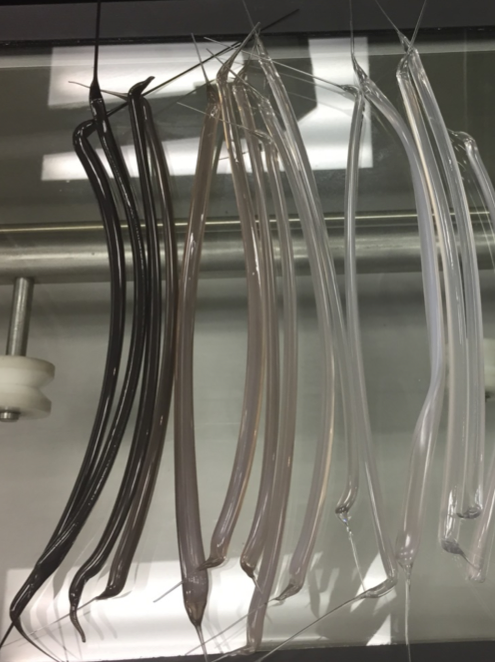
The picture below shows samples taken during a color change of clear PET to dark brown PET.

3 Consider the resin melt point.
If you process materials with significantly different melting points, always run lower melting point materials to higher melting point materials. This will eliminate unmelted gels in the product.
The Disco Purge Method
An effective purge method for product changeovers was introduced by John Vansant of DuPont. It is called the “Disco Purge Method.” According to Vasant, the following procedures can help expedite changeover time after introducing a new polymer:
A general outline of the procedure and issues to watch for are listed below. For a more detailed procedure, please contact Davis Standard.
1. Empty the feed system and make sure it is free of the existing material.
2. Run the existing material down until the top of the screw flight is visible.
3. Avoid the introduction of air into the extruder system when emptying the extruder. (This can lead to gel formation.)
4. Run a range of RPMs to vary the shear rate and change flow patterns. This will help scrub existing resins from slow flow or non-streamlined areas of the system.
5. Be sure to include slower extruder screw speeds to allow resins to bond together and interrupt flow patterns.
6. When changing materials and going to a higher temperature setting, purge the system fully before increasing the extruder temperature setpoints. The lower temperature causes high-shear stresses on the internal flow surfaces when scrubbing the old material out.
7. Never let it “drool;” be active in purging. Running at a low screw speed during changeover will not fully eliminate the existing material. When the screw speed is increased after a drool-type purge, existing material will be released and contaminate the new product.
These common-sense methods are intended to simplify your purging process. Keep in mind that highly dissimilar materials will require additional purging steps. The next blog will discuss the importance of product shutdown and restart procedures.
If you have any questions relating to this blog post, e-mail marketing at marketing@davis-standard.com.
Cheers,
The D-S Connect Blog Team
Essential Feedscrew and Barrel Maintenance Part II

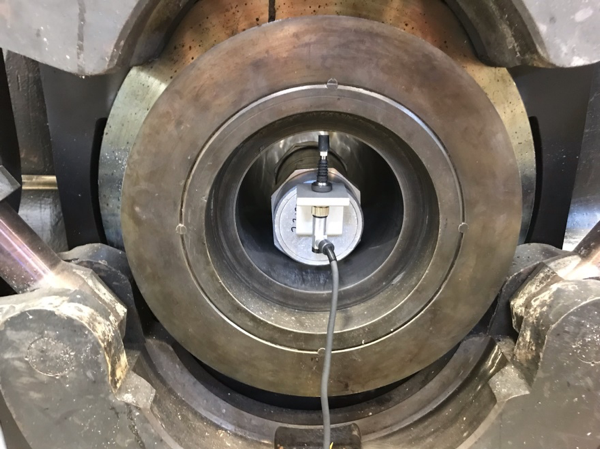
Figure 1. Measurement device placed in extruder barrel
In the blog post, Essential Feedscrew and Barrel Maintenance Part I, we discussed the importance of maintaining the clearance between the screw and barrel on your extruder to ensure that your equipment is operating at maximum efficiency.
The clearance between the screw and barrel will increase due to wear over time under normal operating conditions. This wear has two components, one decreasing the outer diameter of the extruder feedscrew and the other increasing the inner diameter of the extruder barrel cylinder. The rate of wear on the screw is designed to occur at a faster rate than the wear on the extruder barrel. This is done for a practical reason since it is easier to replace the extruder screw versus the extruder barrel. This blog will examine how to accurately measure the inner diameter of the extruder barrel.
The ID measurement is made using a custom electronic micrometer mounted on a movable sled, shown in Figure 1 and 2. The barrel must be very clean and at room temperature. The device is calibrated to the original barrel diameter and positioned in the extruder barrel.

Figure 2. Close up of measurement device mounting sled
The sled is moved, typically in one L/D (Length/Extruder barrel diameter) axial increments along the length of the barrel and readings are taken and recorded. These readings are then compared to the original dimensions showed in Table 1.
Figure 3 below shows the results on a worn barrel that needs to be replaced.

Figure 3. Barrel inner diameter measurement vs. original dimension
Required cleaning tools: wire brush that fits snuggly in the barrel and copper gauze.
Required measuring tools: electronic micrometer
Process: The following steps will ensure accurate measurement and documentation.
- Remove screw from extruder
- Clean barrel at operating temperature – chimney brush mounted on an extension rod
- Allow machine to cool to room temperature
- Using the electronic micrometer, take readings of the diameter along the barrel
- Compare the measurements to the original dimensions by plotting the diameter vs L/D
- If the inner diameter of the barrel is worn to a value that is two times the original radial clearance between the screw and barrel, the barrel should be replaced. See Table 1

Table 1. Extruder barrel inner diameter dimensions
Have questions or a comment about this blog? Please comment below or email marketing: marketing@davis-standard.com
In the next blog post of this series, we will discuss purging methodologies of your feedscrew and barrel. Stay tuned!
Cheers,
The D-S Connect Blog team
P.S. Like what you see here? Please share with your social network!
Essential Feedscrew and Barrel Maintenance Part I
Achieving processing goals, product quality and avoiding unexpected equipment shutdowns are critical for operational excellence and profitability. Ensuring the feedscrew and barrel remain in top condition is an essential part of this equation. In part one of this blog series, we will discuss feedscrew measurement.
Over time and under continuous operating conditions, the feedscrew and barrel will experience wear. The diameter of the feedscrew will decrease and the diameter of the barrel will increase as the screw wears. It’s important to maintain the clearance between the barrel and screw within tolerable limits to avoid processing issues.
The first step is to do an inspection and measure the feedscrew. You will need both cleaning tools and measuring tools to ensure accuracy of your measurements. All of the plastic solidified residue or build-up must be removed from the screw surface. Be careful not to damage the screw during cleaning. DO NOT USE A STEEL WIRE BRUSH OR AGGRESSIVE ABRASIVE MATERIAL. Use brass tools and copper gauze to avoid damaging the surface.
Required cleaning tools: Brass tools that will not damage the surface; copper gauze; others such as econ blast or dry ice
Required measuring tools: 1) OD bar mic to measure the outer diameter of the screw on the flights; and 2) Tape measure to reference the location along the length of the screw
Process: The following steps will ensure accurate measurement and documentation.
- Remove screw from extruder
- Clean screw using tools listed above
- Allow screw to cool to room temperature before conducting measurements
- Establish reference point on screw
- Number the flights along the screw
- Line up tape measure along length of screw and photograph each section showing the flight number and the tape measure
- Using the OD bar mic, measure the OD of each flight along the screw and record measurements in an excel sheet. See figure 1 below.
- Compare the wear on the screw to the original dimensions. Plot the flight number vs. screw OD on a spreadsheet for a visual comparison of the wear vs. the original dimensions. See figure 2 below.
Figure 1: This is a custom made micrometer for measuring the OD of extruder screws. The OD micrometer has been modified with a bar that can span across the flights of the screw that is being measured.
4-5 inch OD mic on a 4.5 inch screw

Figure 2:

The next step is to determine if the screw needs to be rebuilt or replaced. The chart below shows diametrical wear numbers for various screw diameters. These are guidelines and specific cases can vary. With a low number, you may notice a decrease in output at a given rpm. The medium number reveals the screw should be monitored closely with plans to rebuild or replace the screw in the near future. The high number indicates the screw should be rebuilt or replaced immediately. Note: Special high-work barrier screws limit wear to 75 percent of the barrier flight clearance.

In the next blog, we will talk about barrel measurement. Stay tuned and don’t forget to follow us on social media.
If you have any questions regarding feedscrew maintenance, e-mail marketing at marketing@davis-standard.com.
Cheers,
The D-S Connect Blog Team
Feedscrew and Design Truths for Improved Longevity, Part III
In part two of this blog, we covered the importance of the feedscrew materials of construction. In this blog, we’ll discuss how surface treatments or screw coatings can be used to improve screw wear.
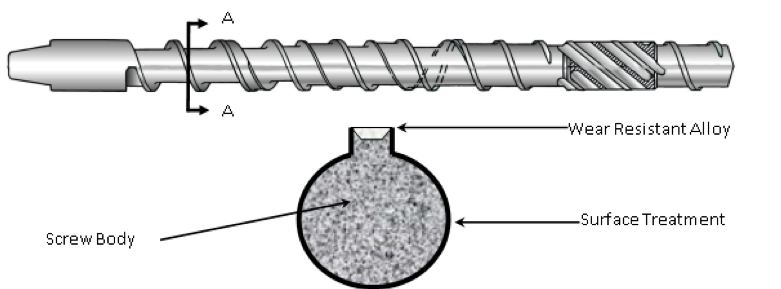
The wear and corrosion resistance of the screw body can be improved by applying surface coatings. These solutions encompass everything from thin metal coatings that protect the surface from the normal wear and tear of cleaning and processing to high- performance materials used to minimize severe abrasive wear. Chrome and nickel plating are widely used for standard applications. For more challenging applications, coatings applied by High-Velocity Oxygen Fueled (HVOF) spray or Detonation Gun Coatings (D-Gun) are available.
Hard Chrome Plating
Industrial hard chrome plating is produced by electro-deposition from a solution containing chromic acid. The metal deposited on the base metal is very hard and corrosion resistant and improves the properties of the base metal. Feedscrews require a minimum of 0.001 – 0.003-inch coating for normal applications. The hard surface provides wear resistance for processes that do not contain high levels of abrasive fillers. The smooth hard surface also minimizes deposits from forming during processing and facilitates cleaning. Although the chrome coating is highly corrosion resistant, it is porous, and will only provide a minimal amount of protection from corrosive materials. It does not adhere to the hard surfacing alloys used for flight treatments.
Electroless Nickel Plating
Electroless nickel plating is used to deposit nickel without the use of an electric current. It is produced by the controlled chemical reduction of nickel ions onto a catalytic surface. This coating provides good resistance to corrosion and wear and can be applied in a uniform manner. It is typically used to improve corrosion resistance because it forms a non-porous coating on the screw base metal. The wear resistance is not as durable as chrome and it is difficult to obtain thick coatings.
Thermal Spraying
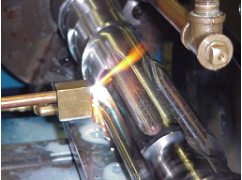
Thermal spraying is a process by which a spray of molten or semi-molten droplets is applied to a surface. Low-energy flame spray techniques are not suitable for screw coating applications due to poor adhesion. High-energy techniques such as High-Velocity Oxygen Fueled (HVOF) thermal spray, and detonation gun coating, (D-Gun®), have been successful. The HVOF process utilizes the combustion of oxygen and fuel gas to produce a high-velocity stream that is used to propel powders at supersonic speeds. The D-Gun® process developed by Union Carbide uses a spark discharge to detonate the oxygen fuel mixture used for acceleration of the particles. The surface finish obtained from this process is much rougher than the plating methods discussed above. A range of materials can be used for this coating process, which provides excellent corrosion resistance. Thermal sprays of stainless steel and nickel-based alloys are common. Coatings containing tungsten carbide have also shown good results.
These processes are only used when all other traditional methods have been exhausted due to the limitations of the application process and expense. It is also important to note that it is very difficult to obtain uniform coatings over the complex geometry of the screw and the direction of application is limited to the line of site. Sharp corners are typically brittle and difficult to coat. Other sophisticated treatment technologies such as vapor deposition and titanium nitriding have been used in a very limited number of applications.
We hope this series of feedscrew blogs has been informational for you. Any questions, please e-mail marketing at marketing@davis-standard.com.
Cheers,
The D-S Connect Blog Team
Feedscrew and Design Truths for Improved Longevity, Part II

In part I of this blog, we reviewed the three types of feedscrew wear, the causes of that wear and corrective actions to eliminate it. In this blog, we’ll cover the importance of the feedscrew materials of construction.
The chemical compositions of the most widely used materials of construction are categorized as follows:
- Standard Materials
- Improved Corrosion
- High Corrosion
- Wear Resistant
- Specialty Tool Steel and Powder Metals
Standard Materials
The most widely-used base material in the industry is AISI 4140. It is a hardenable, alloy steel that offers good machinability and predictable behavior during manufacturing processes. It can be flame hardened to provide a minimum level of wear resistance. A wide range of wear resistant alloys can be applied (via PTA) for improved wear resistance. Another widely used material is AISI 4340. This steel offers improved yield strength when compared to AISI 4140. It is used for extrusion applications that require high torsional strength due to process requirements. Typical applications are small diameter screws and large screws with very deep channel depths. Its torsional strength is 10 percent higher than 4140. It has similar machining and welding characteristics to AISI 4140. Wear resistant alloys can also be applied to this material.
Nitralloy is a material widely used in Europe and Asia. The entire screw geometry is case hardened after machining using a specialized treatment process. This material is not recommended for applications requiring welding, so wear resistant alloys cannot be applied for improved wear protection.
Corrosion Resistant Materials
When a moderate level of corrosion resistance is required, precipitation-hardened stainless steels can be used. The two most popular steel grades for this are 15-5 PH® and 17-4 PH ®. These grades provide corrosion protection similar to 304 Type SS along with excellent physical properties. Higher levels of corrosion protection require specialty alloys that are very expensive. Chromium and nickel-chromium alloys are used in these applications. It is important to note that highly corrosion resistant alloys sacrifice torsional strength for the improved resistance. However, extrusion applications using Fluoropolymers or polymers with aggressive acid byproducts require these materials.

(corrosive wear feedscrew)
Materials Resistant to Abrasive Wear
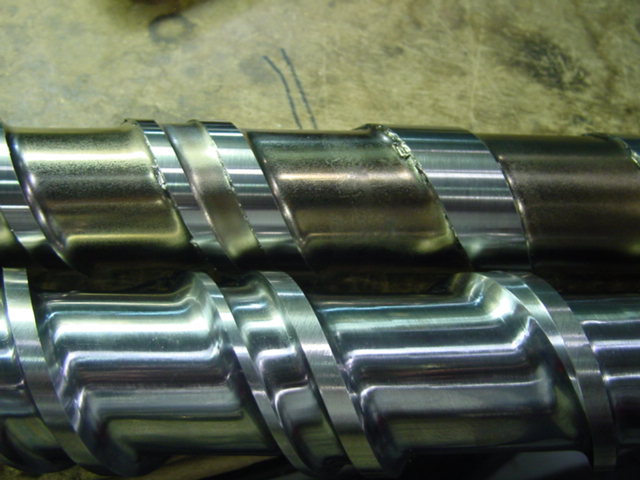
Abrasive wear can occur on both the screw flights and screw root. Wear protection on the screw flight is normally improved through heat treatment or application of a wear resistant alloy. Wear on the screw root is more difficult to correct. Increased wear resistance is normally combated by using harder materials of construction. Increased hardness comes at the expense of the ductility and torsional strength of the base material. For larger diameter screws, the materials selection to correct wear issues is not ideal. On smaller diameter screws, typically less than 2.5 inches (63.5 mm), a variety of material choices are available to correct wear problems. Traditional tool steel and powder metallurgy tool steels can also be employed. These materials provide excellent protection against wear and improve the operating life of the screw. The downside is these materials are very difficult to machine and it’s difficult to maintain straightness during manufacturing. That is why these solutions typically only work for smaller diameter and shorter length feedcrews. For large diameter screws, encapsulation techniques using complex metal alloys are applied over the base metal using HVOF or D-Gun processes.

(abrasive wear feedscrew)
Here is a summary of materials, flight treatments and surface finishes for typical single screw construction:
Standard Materials
- AISI 4140 Cr Alloy Steel, R28-32
- AISI 4340 Cr Alloy Steel, R32-37
- Nitralloy 135M Cr-Al Alloy Steel
High Corrosion Resistance
- Hastelloy C276 (Ni Alloy Steel)
- Inconel 625 & 718 (Ni-Cr Alloy Steel)
- pH Stainless Steel
High Wear Resistance
- CPM 9V/10V
- PM-HIP Fe Alloy Steel
Flight Treatment
- Flame Hardening, RC 53-58 (AISI 4140)
Optional In-Lay Materials
- Colmonoy 56
- Colmonoy 83
- Stellite 6
Surface Finish
- Bare
- Chrome
- Nitriding
In the next blog, well cover how surface treatments or screw coatings can be used to improve screw wear. Any questions, e-mail marketing at marketing@davis-standard.com.
Cheers,
The D-S Connect Blog Team
Feedscrew and Design Truths for Improved Longevity, Part I
At Davis-Standard, we love talking feedscrews and process design. In this blog, we’re going to talk about the three types of feedscrew wear, the causes of that wear and corrective actions to eliminate it. In the next blog, we’ll get even more specific using examples of a groove feed and smooth bore extruder to show how the feedscrew plus process design influences equipment longevity.
There are three types of feedscrew wear: abrasive, adhesive and corrosive. Depending on the polymers you process, these types of wear can be costly and frustrating.
Abrasive wear is categorized by the contact environment and the type of contact. There is two-body abrasive wear that takes place when hard particles from a filled polymer or grit eliminate material from the opposing surface. And there is three-body wear when particles are unconstrained and free to slide down and roll on the surface while under pressure. Ultimately these types of wear cause a fragmentation or cutting action on the feedscrew, eroding the surface.
Causes: Hard particles in the polymer matrix
Corrective Action: Use harder materials of construction (HIP materials) and protective coatings (HVOF).

Figure 1: Abrasive Wear example. New screw on the left, and screw with abrasive wear on the right.
Adhesive wear occurs when there is metal-to-metal contact of two surfaces in relative motion. The small peaks and ridges of the feedscrew collide with the peaks on a twin feedscrew or with the barrel itself, leading to an instantaneous micro-weld. This weld is fractured due to the relative motion of the two surfaces resulting in a “high” spot that will eventually break off. This process continues as the two surfaces alternately weld and tear material from each other.
Causes: Metal-to-metal contact due to poor alignment, an overhung load, thermal expansion, high discharge pressures, incorrect operating conditions or a bent feedscrew
Corrective Action: Use of borescoping equipment, regular maintenance, proper support for downstream and upstream equipment (screen changers, melt pumps and feed systems) and correct installation practices are essential.

Figure 2: Adhesive wear example. New screw to the left and top of a screw flight showing adhesive wear to the right.
Corrosive wear results when a corrosive material attacks the surface metal. Corrosive polymers such as some PVC’s, corrosive flame-retardants and fluorocarbons are common culprits. The feedscrew and barrel are essentially destroyed through an unintentional chemical or electrochemical action causing pitting and surface roughness.
Causes: Polymers that evolve during processing or degrade during heat-up or shutdown; EVA, EMA, EMAA, EAA and other ionomers; those that contain chlorine and/or fluorine such as PVC, CPVC and FEP, PVDF, ETFE, ECTFE
Corrective Action: Select the appropriate materials of construction or apply protective coatings that do not react with the polymer or degradation of products by the polymer (ie. nickel coatings, high-nickel alloys).

Figure 3: Two examples of corrosive wear.
What if you take the corrective measures above and still experience excessive wear? It happens. The next blog will share how process design comes into play.
Have questions? Comment below or e-mail marketing at marketing@davis-standard.com.
Cheers,
The D-S Connect Blog Team
Troubleshooting the Drive and Motor
Safety & Warning Hazard note: Working on an electrical drive and motor system is hazardous and can lead to injury or death. All work on the motor and drive should be done by qualified, licensed electricians. This troubleshooting blog is intended as a guide to offer suggestions only.
You begin to notice motor speed issues, loud noises or see high-load readings for the drive. What’s going on and where do you begin? It may be a wiring connection, an alignment issue or maybe something was not set up correctly during installation. Or, maybe you just need to auto-tune the drive to the motor, which is a common requirement of most AC drives today. Whatever it is, it needs to be fixed!
The first and most important step before diagnosing the problem is to refer to your drive manual and follow those instructions. Also, ask the following questions:
(1) Has this been occurring since installation or is it a new issue.
(2) Has anything been changed with our process, materials or procedures?
(3) Have we recently changed any components?
(4) Is the motor or the drive the issue? Isolate the problem area.
To check the motor, run it at a safe, set speed. Engage the emergency stop or another means of decreasing power. If the noise continues as the motor speed declines, it’s most likely a mechanical issue. Consult the OEM or motor manufacturer for assistance. If the noise stops, it’s most likely an electrical issue and additional troubleshooting is needed to determine whether it’s drive or motor-related. Motor winding breakdown, a faulty encoder (if installed), and loose wires can cause erratic motor performance. Poor drive tuning or wiring can also contribute to insufficient motor performance and speed regulation. Consult a drive manual regarding tuning procedures.
Another common issue is with basic drive operation. For drives that fail to start, check to see if there is a command at the drive input. If not, the issue is probably control circuitry. If this is an existing installation that has been operating fine and the command is not present, it may be a bad component such as a relay causing the problem. If there is a command, confirm there are no other open inputs such as an emergency stop or motor-blower. If external inputs appear to be satisfied and power is applied to the drive, the issue is internal to the drive and it will likely need replacement. Typically, internal drive faults are displayed on the drive’s digital keypad.
For high motor load readings, the first step is to inspect the motor and confirm the load reading from the drive is correct. Load drive indication is calculated based on drive readings and can be inaccurate if the drive is not configured correctly. If the indication is correct, confirm the process is within the rating of the motor as designed. If the process has not been changed and the issue is new, inspect mechanical connections to confirm there is nothing prohibiting the motor or screw rotation. A low barrel temperature can cause material viscosity issues, which would affect both motor performance and load. If everything checks out, consult the motor manufacturer or an authorized repair center.
We hope these troubleshooting tips help! To contact us for more information, e-mail marketing@davis-standard.com.
Cheers,
The D-S Connect Blog Team