

New Year’s Resolutions – 10 Habits for Operational Excellence!

Welcome to 2023! With the onset of a new year, it’s the perfect time to review and revive best practices in order to achieve peak equipment performance and product quality. In this blog, we’ll provide 10 resolutions we believe are instrumental to supporting internal efficiencies while providing the best results for your customers.
Resolution 1: Prioritize Safety

Resolve to recommit your team to daily safety practices. This includes highly visible safety signage on the shop floor, recognition of safety excellence, and a company-wide safety checklist with your top priorities. We put together a list not too long ago that you can access here.
Resolution 2: Review Equipment Checklists

Now is a good time to review maintenance checklists for every major line component as provided by your equipment manufacturer. The extruder is a good place to start. Get your free printable PDF extruder checklist here.
Resolution 3: Align Your Extruder
![]()
A poorly aligned extruder causes excessive wear and tear on both the screw and barrel. Here is a short read about extruder alignment and a step-by-step video tutorial on borescoping.
Resolution 4: Clean Your Feedscrew

Periodic purging of your extruder and cleaning your feed screw can improve your overall product quality. To help, we have included a step-by-step purging video.
Resolution 5: Assess Your Capabilities

Are you getting the most bang for your buck from your equipment? How is your energy consumption? Are there ways to reduce waste? What factors could improve outputs and profitability? How can you improve operator effectiveness? A system assessment by your equipment manufacturer may lead to big cost savings and better results for your customers with a few cost-effective upgrades. If you wish to schedule your assessment, contact us here.
Resolution 6: Celebrate Employees

Let your employees know they are appreciated! If you do not already have an employee recognition program, consider implementing one. Periodic recognition, staff celebrations, and employee success stories work wonders for boosting morale. Here are some great links from the following companies that offer inspiring and creative ways to give recognition:
Culture Amp
Snack Nation
Insperity
Resolution 7: Purge the Junk

Purge the junk from 2022 before the end of January. This not only includes junk on computers (e-mails, obsolete apps, etc.) but physical junk on the shop floor or in the office area. What can you recycle? Visit your local government website for proper recycling methods and procedures. Consider doing this practice monthly or bi-monthly to keep technology primed and your facility immaculate.
Resolution 8: Get Involved in Your Community

If your company is not already involved in the community, look for ways to make your presence known. What local charitable or business organizations align with your company’s philosophy? For those organizations or causes you already support, what are some ways you can improve or alter your involvement? How can you encourage employees to get involved? Whether it be a community clean-up, food or clothing drive, donation to a local cause, sponsorship of an educational event or something else, it’s important that all of us in the industry do our part to make our communities better.
Resolution 9: Reconnect at Industry Events

It’s important after the past few years to reconnect with each other in person. Take advantage of these opportunities to collaborate and meet with fellow industry leaders face-to-face. Some of the events Davis-Standard is attending in Q1 and Q2 can be found on our events page here.
Resolution 10: Read the DS Connect Blog!

For your last resolution, please repeat after us: “I resolve to read the DS Connect Blog every month.” 😜
Our team of experts regularly collaborate to provide you with timely information that supports your manufacturing team and process improvement. By frequenting our blog, you will receive high-quality content twice a month, direct to your inbox. Encourage your staff or colleagues to sign-up as well. If there is a topic you would like to see covered, let us know!
We wish you a prosperous year full of new innovations, many successes, and a healthy bottom line. Any questions, e-mail marketing or drop us a line in the comments below!
Cheers,
The D-S Connect Blog Team
Top Five Most-Read Blogs of 2022!

The results are in! And we’re happy to report you continue to enjoy the content our D-S Connect Blog team puts together just for you! Our goal is to provide valuable educational content that supports you and your teams – when you’re happy, we’re happy! Without further ado….Here are the top five blogs earning your readership in 2022.
(Click the titles to read each blog in a new window)
#5. Preventative Maintenance for Davis-Standard Gear Reducers – Oil Change Intervals
Coming in at number five is the first post of our gear reducer maintenance series, oil change intervals. In this blog, we outline oil change intervals for gear reducers without oil filtration and those with oil filtration. We also provide inspection suggestions during each oil change and on a daily and monthly basis.

#4. Feedscrew Wear Guidelines for Best Results
At number four is an extension of a previous feedscrew blog series from 2019. This one covers basic diametrical wear guidelines to assist you in knowning when to rebuild or replace your feedscrew. This one is a quick read with a chart showing guidelines for different feedscrew diameters to help you identify low, medium and high wear.

#3. Extrusion Coating Versus Adhesive Lamination, Part III, Performance Parameters
Coming in third, as part three of a series on extrusion coating and lamination, we summarize performance parameters when running an adhesive lamination structure via extrusion coating. These parameters include rigidity, seal initiation temperature (SIT), seal strength, coefficient of friction (COF), and the ability to handle heat created during the extrusion process.

#2. Troubleshooting Common Pellet Quality Issues
In second place, we reviewed 13 common pellet quality issues with photo examples, defect names, possible cause, and troubleshooting steps for correction. This blog is focused on helping you more easily define defects and proactively work to eliminate them to achieve high-quality pellets.

#1. Troubleshooting Common Blown Film Issues
Topping our list for the SECOND year in a row is our blog on troubleshooting common blown film issues! This blog summarizes various blown film defects, the causes and solutions, to facilitate uniform films with high tensile strength and reliable barrier properties.

Thank you for your continued support of the D-S Connect Blog. We look forward to giving you more valuable content in 2023, so stay tuned. We invite you to share the D-S Connect blog with your colleagues.
Share this QR code:

OR share our email subscription landing page so your colleagues can get the DS Connect Blog right in their inboxes.
Is there a topic you want to learn more about? Let us know in the comments below ⬇️
Happy holidays! We wish you a healthy and profitable year ahead! For any other questions, e-mail marketing.
Cheers,
The D-S Connect Blog Team
Resources to Up YOUR Game!

Who says less is more? When it comes to resources, we say the more the merrier! After all, you have a lot on your plate running a world-class operation. If we can give you one less thing to worry about, we’re pleased to oblige!
That’s why we’ve developed an extensive portfolio of resources to help your operation run like a well-oiled machine. Your profitability depends on maximum efficiency, consistent productivity, greater up-time and responsive service. Our engineering, manufacturing and aftermarket teams collaborate on a regular basis to ensure we’ve got you covered. Tap into this knowledge base any time.
Technical Resources
We like to share knowledge and offer access to white papers and informational blogs written by our in-house experts. You’ll find lots of good information about a host of topics and applications. You can access them any time and share with your colleagues.
-
- D-S connect blog: Download and save this PDF to access the topics most important to you. We have a wealth of action-driven content to make your company, operations, and processes better – for your bottom-line! Just click on any title in the document and it will bring you to the blog post of your interest.
-
- Resources Center: For all product-specific downloadable PDFs
-
- White papers including technical articles and tech tips
Below is to help you navigate the resource page to find technical articles. Feel free to email marketing if you need help.

R&D Capabilities
Your innovation is a priority! We are continually developing and testing new technologies and invite you to do the same by taking advantage of our laboratory capabilities. Our labs are available to you for proof of concept, product trials, machinery qualification, and so much more. Different lab locations offer different capabilities and are set up with various control technology. If you are interested in setting up a lab consultation, inquire here.
Pawcatuck, Conn., USA: Testing for single screw extrusion (sizes ¾ inches (19mm) to 4.5 inches (114mm), coextrusion sheet applications, smooth and groove feed applications, and medical tubing in a clean-room environment.
Fulton, New York, USA: Testing for converting processes with capabilities for unwind and winding, extrusion coating, lamination, cast film, liquid coating and pelletizing.
Suzhou, China: Testing for high-speed FPVC extrusion and microbore tubing.
Vantaa, Finland: Testing for a range of wire and cable and pipe and profile processes, including an extruder laboratory and capabilities for HV and EHV cables, LV jacketing, high-speed buffering, flexible factory joints (AC and DC), and more.
Machinery Upgrades and Parts
We offer multiple aftermarket services to support you. This includes equipment upgrades, replacement parts, custom engineering and existing equipment analysis. Did you know we can do a line audit to see what upgrades may be beneficial? Inquire today!
-
- AC motor and drive conversions
- Air-to-water conversion packages
- Die and head upgrades
- Drive system integration
- Feedscrew replacement and rebuilding
- Gearcase retrofits
- Internal diameter increase (IDI) conversions
- L/D conversions
- Melt pumps
- Proces control upgrades
- Splicing upgrades
- Total line upgrades
- UEM (Used Equipment Remanufacturer)
- Web handling
24/7 Customer Service
We have an entire team dedicated to answering your call, 24 hours a day, 7 days week, 365 days of the year. Our customer service hotline (844-MYDAVIS) is a global number and you will automatically be directed to the appropriate location and department for your needs. We also have service numbers according to location:
Davis-Standard, CT: +1-800-480-8105
Davis-Standard, NY: +1-800-338-3660
Brampton Engineering, Canada: +1-647-262-8031
Davis-Standard Limited, UK: +44 (0) 1384 471930
ER-WE-PA GmbH: +49 173-710-6407
Maillefer, Finland: +358 40 773 0339
Maillefer, Switzerland: +41 21 694 4100
Suzhou, China: +86 189-1319-6058
Deacro, Canada: +1-905-564-6566
Thermoforming Systems, LLC, WA: +1-509-454-4578
Davis-Standard Emails
Are you signed up for our emails? If not, please feel free to sign up here. We share company news, provide educational content from our experts, offer tradeshow discounts, send quarterly newsletters, and so much more! You can even update your preferences to choose what types of content you would like to receive. Stay in the know and sign up today!
Seminars
Last but not least, we offer a spring and fall seminar that takes us back to the basics. Appropriately named, The Basics of Plastics Extrusion seminar is one of the most popular in our industry. The positive feedback from attendees has been off the charts!
We recommend this seminar for anyone who is new to the extrusion process. This seminar is also beneficial for anyone who needs a review of extrusion fundamentals. Do not hesitate to add yourself or anyone else to the seminar waitlist. Those on the waitlist receive first notice of open registration before we go public! Each seminar only has 25 seats to ensure an ideal student-to-teacher ratio, so getting on the waitlist is ideal! For a list of topics covered during the seminar, click here to view a sample agenda.
We hope these resources help you with what you need, when you need it. Please feel free to bookmark this page for future reference. If you have any comments or questions related to this post, comment below.
For any other needs, please e-mail marketing.
Cheers,
The D-S Connect Blog Team
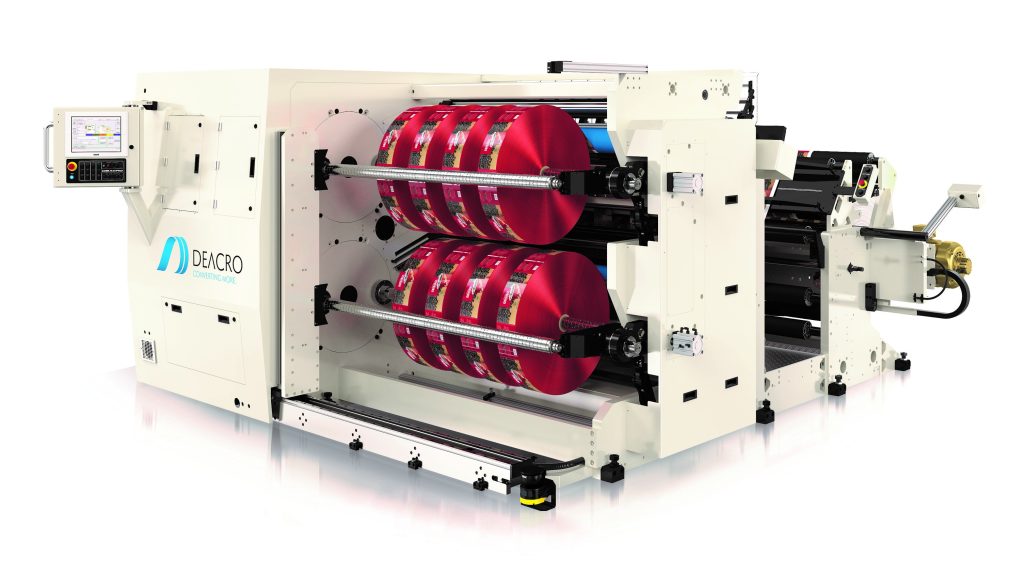
Maximizing Labor, Time and Safety with Slitter Rewinder Automation

The converting industry continues to face limited labor resources and tighter profit margins. You are challenged to do more with less, thus the growing need for machinery automation. How can you take advantage of full or partial automation of the slitter with turret rewind technology to enable one operator to do the work of three when compared to non-automated? In this blog, we’ve listed various automation solutions to support your productivity for processes such as medical and flexible packaging, pressure-sensitive labels and tapes.
- Turreted rewind – One operator can unload rolls and position cores during slitter operation.
- Auto web cut and transfer – Cutting the slit roll tails and transferring tails to the next core is automated, saving time cutting webs and taping, and aligning webs to the next set of cores.
- Razor web cut-off or optional shear/score – This enables cutting before turreting to keep tails short and maintain web alignment/tension on outside wraps while eradicating waste.
- Auto core positioning and placement – With laser positioning, auto core loading from the hopper and auto core placement and cutting, the cores can be cut, loaded and positioned onto rewind shafts without minimal or even no operator intervention.
- Digital knife positioning – By using a digital operator, knife positions are saved in a file recipe database and a digital tape measure shows the correct position. No manual measurement is needed and placement is accurate every time.
- Auto knife positioning – This feature can be fully integrated into slitter controls for handling razor/shear or score knives — including auto-calibration and auto-knife position verification.
- Auto roll unloading – Rolls can be automatically pushed off the rewind shaft with several receiving stations available per application. This eliminates manual movement of heavy rolls from slitter rewinder shafts. You can also implement palletizers with pivot features to prevent unnecessary lifting and bending, essentially allowing rolls to reach the pallet without any operator contact.
- Auto web taping – This reduces operator involvement for inside web taping, outside roll taping, label application to tail-tie rolls and end-of-roll warning tapers.
- Automated setup – There are several ways to automate setup in order to avoid unintended errors and provide time savings. This includes unwind roll auto-centering, web guide positioning, auto lock rewind tooling, dual-durometer lay-on capabilities, and cantilevered rewinds to eliminate shaft handling.
- Auto roll packaging – By using robotic arms to automate the labeling, weighing, wrapping/bagging and pallet wrapping processes, manual labor is not necessary to package finished rolls.
- Industry 4.0 – To support operator education and productivity, consider using a cloud-based platform such as DS Activ-Check™ to take advantage of remote technology support, data acquisition, third-party data interfacing, remote communication, tension monitoring, warning notifications, and more. Early notification of potential failures, accumulating valuable data for process improvement, and using configurable dashboards are the way of the future. Following are examples that contribute to consistent roll quality, regardless of operator experience level.
- Tension mapping assists maintenance staff in identifying changes in tensions from wear, allows verification of tensions throughout roll buildup, and uses a feedback loop for auto-correction.
- Database file management acts as a training aid for new operators. Operational parameters can be saved for easy recall, repeatable processing and consistent rewind quality.
What steps should you take to add automation and get the most out of existing machinery and operator resources? The good news is, upgrades on existing equipment are readily available, and we can do a machinery performance audit to determine the most feasible approach. We can evaluate some or all of the automated options mentioned to see what is best for your operation and budget.
In addition to machinery automation, we can address questions you may have about operator safety protocols. This includes items such as adding safety fencing with access gates, non-physical barriers using PLS safety scanners, light curtains as required by application, programmable safety circuits and safe speed operator access during setup. We also recommend regular, preventative maintenance and equipment care for best results.
Based on the number of high-growth markets that require slitter rewinder technology, investing in automation is a worthwhile endeavor in terms of labor, time and safety.
Questions about this blog? Comment below ⬇️
How is your machine running? Want a FREE machine audit to find out how you can get improvements with output, safety, automation, and more? Contact us here.
Any other questions, e-mail marketing.
Cheers,
The D-S Connect Blog Team
The Ultimate K Show Tool Kit

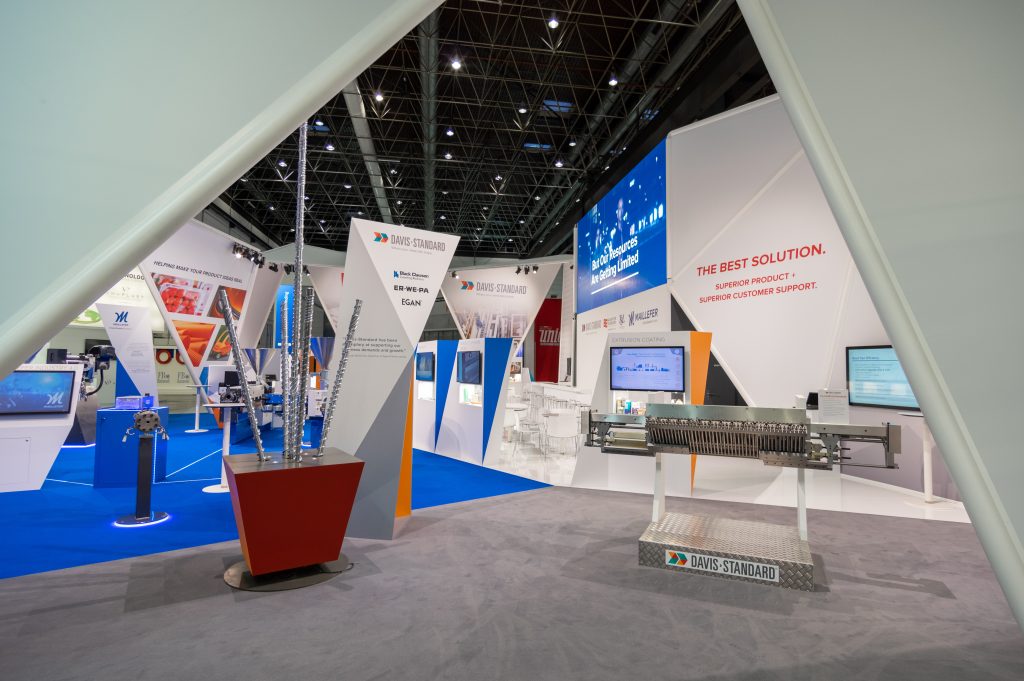
It’s that time again! Time to pack our bags and head to Düsseldorf, Germany for the world’s #1 trade fair for plastics and rubber – K 2022. Are you ready to get the most out of your visit as you walk miles and miles checking out the latest technology and trends? And the endless opportunities for networking and sharing ideas? It’s almost time, so let’s take a look at some things you’ll need to know before and during the show!
A refresh from our K 2019 posts, this tool kit provides tips for surviving K along with a resource list to help you navigate Düsseldorf and more! A good post/resource to bookmark. 😉
DS TEAM SURVIVAL TIPS:
1) Be nice to your feet. We recommend shoe inserts and foot powder! DO NOT under any circumstances save new shoes for the exhibition. Blister city! You should be breaking in a new pair of shoes (or two pairs) now.
2) Take a night or two off. While it’s tempting to participate in something every evening, we recommend taking a few nights off to catch up on some extra sleep. Your body and mind will thank you.
3) Bring a spare belt. Be warned…eating good food, including many Schweinshaxe at the Zum Schiffchen expands your stomach. Two to three inches have been recorded in the first three days! At past exhibitions, the “belt repair clinic” has been a hotbed of activity for repairing buckles and adding belt holes. A larger belt is a good fallback.
4) Carry a sewing kit. As with an expanding waist, shirt buttons may begin to pop! A sewing kit with spare buttons is cheap insurance.
5) Pack supplemental vitamins. Boost your immunity with vitamins C, B6 and E.
6) Hand sanitizer and KN95/N95 masks. Need we say more after the past two years? There are also many rapid test centers in Düsseldorf if needed.
7) Include face cloths for showering. Most hotels in Germany do NOT supply these and they are nice to have after a long day.
8) BEWARE: samples galore and only two arms. You will be tempted by Darth Vader masks, plastic chair parts, and others partly or fully built home components. We suggest traveling light and being selective with the cool samples.
9) Walk to the show. If the weather is nice and your hotel is close, take the opportunity to walk to the show. It’s good exercise, clears your head from the night before, and gives you time to prepare for the daily grind.
10) SECURE YOUR PASSPORT AT ALL TIMES. A replacement passport will take at least one full day, discussions with multiple people, and give you one heck of a headache. Knowing where your passport is at all times is essential! Just in case:
-
-
- Keep a copy of your passport ID page in your bag/briefcase
- Snap a photo of your passport on your phone
- Report stolen passports to local police immediately
- Report misplaced passports to your embassy or consulate
-
11) Be aware of your surroundings. Crowded venues and public transport are prime areas for pick-pocketing and credit card scanner theft. Avoid traveling alone; best to travel in pairs or groups.
12) Carry some Euro coins. Take care of the restroom attendee.
13) See the sights! Hofgarten Park is recommended for a quick run or walk through the upscale Königsallefor some window shopping. The Hafen Harbor District has some tasty and modern restaurants. The walk along the Rhine from the show to Altstadt makes that first beer all the more worthwhile!
14) Enjoy German beverages. You must drink Killepitsch while in Dusseldorf (a local herbal liquor). The local beer in Dusseldorf is Alt. It would be blasphemous to order a Kolsch (the beer from Cologne; a neighboring and rival city). But if your hotel is in Cologne, don’t dare order an Alt. It gets complicated…
15) Be prepared for the weather. Mid-October in Germany can deliver the unexpected, so pack accordingly. Most veterans ponder whether to bring an umbrella or not on a daily basis. If you don’t like getting wet, we say bring it.
16) Don’t forget your favorite pain reliever. Days and some nights can be long! Advil® and Tylenol® work well.
17) When in doubt, ask your K savvy colleagues.
HELPFUL RESOURCES TO GET YOU THROUGH:
Safety first!
Need medical assistance or have an emergency? This medical assistance link provides the contact information you need to ensure a safe visit.
Transportation convenience
The most convenient way to get and to from the fair is by train. Here is how you get from point A to Z and everywhere in-between:
-
- The central train station is situated in the city center. In the hall, you will find two mobile information stands of Messe Dusseldorf. During the trade fair, buses and metro lines U78 and U79 run regularly between the train station and the exhibition center.
- Information and reservation at the railway station: Tel: +49 211 11861
- Timetable (auto announcement): Tel: +49-800 1507090
Deutsche Bahn AG
Tel: +49 0180 6 996633 (service number for the train)
Tel: +490180 6512512 (mobility service for barrier-free travel
Address: Immermannstr. 65c, 40210 Düsseldorf
Website: www.bahn.de
Book or rebook your plane and rail tickets – use the traveler services
Visit: Messe Center, First Floor
Monday to Friday, 9 a.m. to 5:30 p.m.
BCD Travel Germany
GmbHReisestelle
Messe Düsseldorf Stockumer Kirchstr. 61, Messe Center, 1.OG
40474 Düsseldorf
347.01@bcdtravel.de
www.bcdtravel.de
Phone: +49 30 403 652 117
Fax: +49 30 403 655 3676.
Travel Assistance
Need international support for travel assistance or to get in touch with your nation’s embassy? This website provides 77 foreign representations for 141 countries, including seven international subsidiaries. They offer a variety of services around the fair for visitors, exhibitors and the press.
K Talk! Live
Don’t miss the new web talk format of K 2022 @ https://www.k-online.de/de/K-Talk. Tune in for live and on-demand presentations and discussions offering insights on technological innovations and challenges facing the industry. Join experts from around the world as they dive into the circular economy, sustainability, digitization, new strategies and industry-forward developments.
K Magazine
Need some good reading on route to the show? K Mag offers you a wealth of information surrounding industry news, the diverse plastics landscape, consumer topics, science advancements, new application areas, young professionals and more. And it’s not just for K, you can enjoy 365 days of community news! Check it out @ https://mag.k-online.com.
Get the app!
Here is the Apple store link and Google play link.
Post-show activities
Everything you need to know about Düsseldorf tourism (accommodations, shows, events, site seeing, restaurants, etc.) can be found here.
Looking for a service not included in this list?
Check out this link.
WHAT’S IN STORE FROM DAVIS-STANDARD….
For a little pre-show excitement to get you pumped up and ready to roll, check out these videos:
Davis-Standard promo:
K Show promo: https://www.k-online.com/
We’ve got a lot waiting for you in Hall 16, booth A43, so please add Davis-Standard to your show planner!
Schedule appointments now for the show so we ensure ample time with you! Fill out this form and a representative will confirm your reservation.
We look forward to seeing you in a few weeks!
For questions about how Davis-Standard can support your process efficiency and profitability, contact us here.
Any other questions, feel free to comment below.
Cheers,
The D-S Connect Blog Team
Prioritizing Sustainability & The Circular Economy

Sustainability is the key to a better future and is constantly evolving to improve the quality of our lives. Focusing on the economy, our society and the environment, can simultaneously help meet our own needs as well as the needs of future generations. The pursuit of a more sustainable lifestyle is reflected in consumers, leading to changes in their purchasing behaviors. According to the Economist Intelligence Unit, over the past five years, there has been a 71% rise in online searches for sustainable goods globally. So, what does this mean for you? As a manufacturer, it means supplying the ever-increasing demand for more sustainable product. That is no longer a future need, it’s happening right now!
In the manufacturing industry, we know sustainable machinery technology and environmentally-sound processes are critical to our future business success and ability to support new product innovation. Priorities such as reducing material waste, conserving energy, increasing recyclability and strengthening processing efficiency are at the forefront of achieving the ideals of a circular economy. This diagram from the National Institute of Standards and Technology (NIST) does an excellent job of illustrating this approach.

We also know that integrating sustainability is a process that can’t be done overnight. It requires time, prudence and a significant investment. We must also address each facet of manufacturing from how we operate the shop floor, to R&D efforts, to new technology application, to ongoing machinery development.
Here are some questions to help guide the process:
(1) What have you implemented to start or continue on the path to sustainable manufacturing?
(2) Do you know what options are available to help support your sustainable goals?
(3) Are you working closely with your machine manufacturer to help implement better energy efficiency?
(4) Are you working closely with your machine manufacturer to improve how your machine operates to deliver a more sustainable product?
Following are some ways Davis-Standard is participating and working with processors to support our industry’s sustainability goals. Anything we do is a step in the right direction!
- Improved manufacturing practices: According to Forbes magazine, manufacturing entities use one-third of the world’s energy. We must do better. Maybe you’re already using alternative energy sources for production. At Davis-Standard, we’re working on increasing our procurement of carbon pollution-free electricity to 100 percent of our total energy usage. In addition, machinery can also help with power consumption. The next few bullets will outline a few examples. You may also consider attaining current environmental certifications such as ISO 14001, the international standard for environmental management systems (EMS).
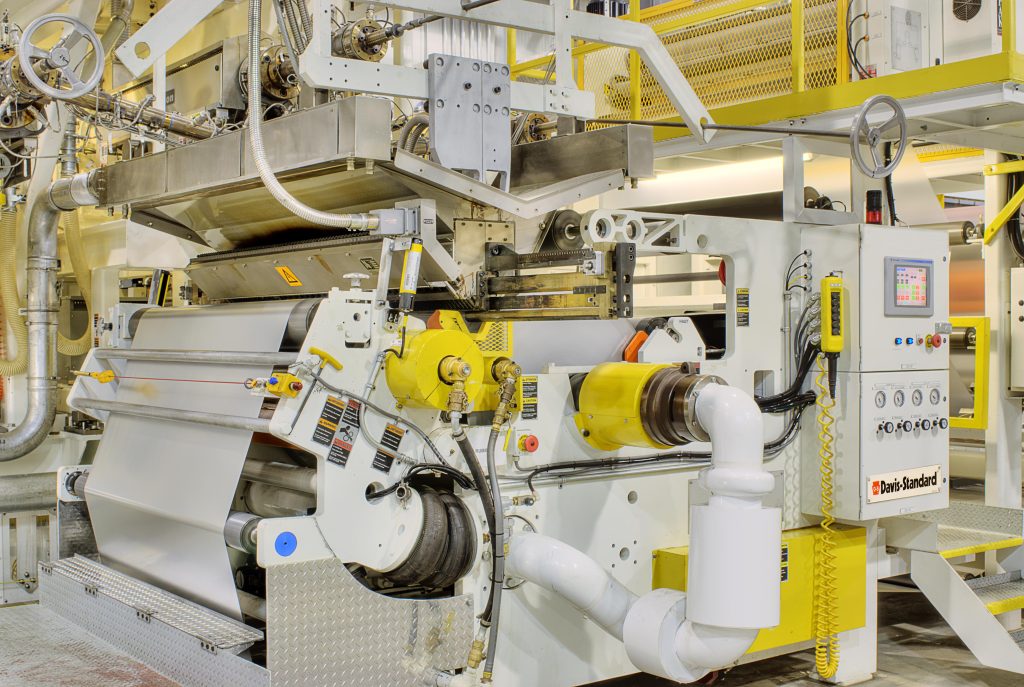
- Ongoing machinery development: Moving toward sustainability does not mean we have to reinvent the wheel. We can take what we know about existing machinery and merge that with what we are learning about better processing outcomes. Machinery that offers space savings, improved transition times, reduced raw material loss, flexibility in extruder upgrades, and output quality improvements can serve BOTH the environment and the bottom line. Two recent examples at Davis-Standard are our SHO groove feed extruder and the CHP extruder for extrusion coating. Both of these machines excel in reducing power consumption and minimizing waste while providing higher outputs.
- Digitalization technology application: Integrating digital technology is fundamental to helping all of us work smarter. Industry 4.0 platforms support visibility in the production process, including a better understanding of energy usage, production parameters, equipment function, and allowing for predictive and preventative maintenance. Davis-Standard’s new DS Activ-Check™(trackable link to digital brochure here) platform is an example of a digital solution that offers a suite of analytical tools, cloud and local data storage options, and process and equipment technology algorithms.
- A commitment to R&D: What are you doing on the R&D front? How can your efforts be improved, and how can your OEM collaborate with you? We just recently adopted a direct funding initiative, targeting five percent of sales revenue, toward sustainable equipment development. With customer input, we’re focusing efforts on further expanding use of recycled content, reducing material waste, and efficient use of energy and process structures. We’ve also discovered the benefits of greater extruder insulation in reducing a machine’s carbon footprint, the benefits of energy-efficient barrel and motor designs, and potential savings when integrating a recycling system for edge trim.
- New material exploration: As another aspect of R&D, what are you doing in terms of new material/resin use and exploration? Using compatible structures with end-of-life recycling qualities is significant to the circular economy. For example, addressing machinery requirements for processing biodegradable resins such as PLA, PHA, and TPS. Davis-Standard offers fully equipped laboratories to conduct extrusion performance studies with biodegradable resins to study melting behavior, output, melt quality and produce samples for performance testing.
Working together to meet your customer and environmental demands is paramount to a successful future for all! We wish you well on your sustainability journey as we work together as an industry to make an impact. We also hope you’ll partner with us to collaborate as we develop new technologies that better serve your business and the circular economy.
If you’re looking for R&D services, please contact us here to set up an appointment with one of our facilities.
Are you looking to make your equipment more sustainable? Contact us here if you would like an evaluation of your equipment with a complete line audit.
Any other questions or inquiries, e-mail marketing.
Cheers,
The D-S Connect Blog Team
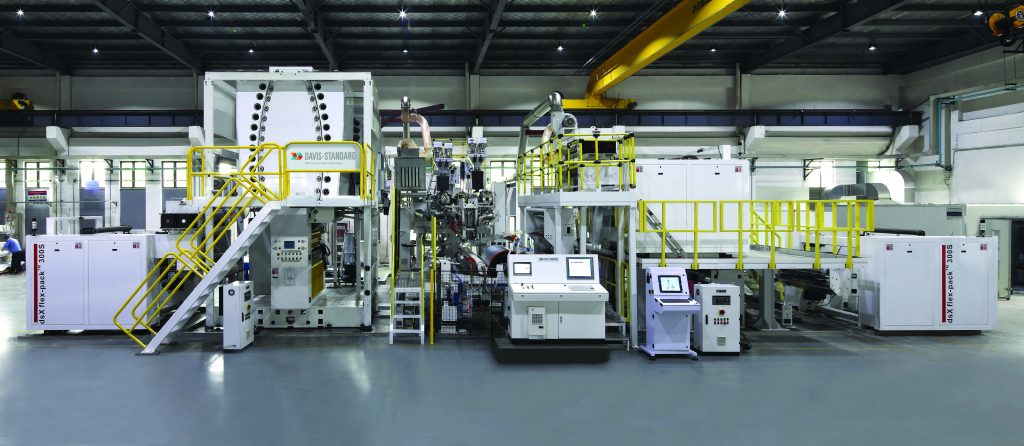
Extrusion Coating VS. Adhesive Lamination, Part III | Performance Parameters

In parts one and two of this blog series, we outlined environmental advantages and cost considerations when comparing extrusion coating to adhesive lamination. In the third and final part of this series, we take a look at performance.
PERFORMANCE
The bane of any flexible package is a leaker! The area susceptible to leaking occurs at the fin seal, which is created on a vertical form fill and seal machine. When the clamps close down on the fin seal and then release, stresses occur at the hinge point. When the clamps are opened, the fin seal will attempt to normalize those stresses by reverting back to its position before being clamped. If an adhesive is used, it is very thin and brittle. Those stresses cannot always be normalized and can result in a void. This seal area has been given the very colorful moniker, the “triangle of death.” Extrusion coating is thicker and more caulk-able, helping reduce stressors, which can lead to the “triangle of death.”

However, running an adhesive lamination structure via extrusion coating is not as simple as replacing the adhesive with an extrudate. All performance parameters must be maintained during that transition. These include rigidity, seal initiation temperature (SIT), seal stretch, Coefficient of Friction (COF), and the ability to handle heat created during the extrusion process.
Rigidity – In the last blog, we mentioned that extrusion coating could save money by providing more “pellet-to-product” opportunities. However, rigidity mustn’t be compromised when attempting to replace more of your structure with extrudate either through a reduction in thickness or elimination of the sealant substrate. To combat this potential deficiency, you can work with your resin manufacturer and increase the density of the resin you use, as long as the change will not affect your SIT. You can also run a warmer chill roll to increase the crystallinity and density of your extrudate, as long as it can be easily stripped off the chill roll.
SIT – Any change in a structure’s sealing surface needs to be reviewed to ensure you don’t adversely affect the seal initiation temperature. Form, fill, and seal processers rarely know if the structure being sealed is coming from extrusion coating or adhesive lamination, so having a SIT that is too high can cause problems. You can try to increase the temperature of the sealing clamps, but it would be easier to evaluate if the resin has the right melt index and density for the job. Alternatively, coextrusion or a resin blend may provide the needed SIT.
Seal Strength – Stiffer blown film resins used for a sealant in adhesive lamination can result in stronger bonds. To make up for the difference using extrusion coating, you may need to blend the LDPE with tougher, metallocene catalyst resins such as m-VLDPE or m-ULDPE. Or, run these resins “pure” or in a coextrusion arrangement.
COF – When running a lamination on a vertical form, fill, and seal machine, you need to pull the inner substrate over the forming cone. To do this effectively, the COF of the inside layer must be less than the outside layer. An adhesive lamination using a blown film sealant has an inherent advantage because the blown film normally uses a slip agent, which reduces the COF. If you run an extrusion coating lamination without a blown film sealant, you must add slip, use a matte chill roll to reduce inner layer contact with the roll, or replace the forming cone or collar with a lower COF one.
Heat – The heat from the extrudate is the most significant difference when comparing an adhesive lamination structure to an extrusion-coated one. It is important to review how substrates tolerate heat. Following are some key points:
-
- Metalized films need to be designed with extrusion coating in mind. If not, heat can instigate differential expansion between the metalized material and cause crazing. If the metalized film is OPET, this is not an issue. But, it can be an issue when running an OPP. Any differential expansion over 4 to 5 percent can result in crazing. There is no issue running metalized film in extrusion coating; just don’t assume the same metalized film will suffice for adhesive lamination.
- To reduce crazing, adjust the extruder carriage so it is closer to the primary substrate side, and run the metalized film on the auxiliary side against the chill roll. You can also consider lowering the melt temperature as long as it doesn’t affect bond integrity.
- If the initial structure is significantly asymmetrical, heat and subsequent cooling can result in curl as one side cools quicker than the other. Solutions include annealing after the laminator, adjusting tension control, or moving the extrudate closer to the thermally-stable side of the structure. Replacing the extrudate with a lower-density resin will result in less shrinkage when cooled to potentially reduce curling.
- It is important that heat from the form, fill, and seal clamp migrates through the structure into the seal. Extrusion coating can have a larger plastic component, and plastic can act as an excellent insulator. Before replacing a thin adhesive with a thicker plastic extrudate, the sealant temperature should be investigated. The solution may be a hybrid structure using both adhesive and extrudate.
- Heat can also cause issues when subjected to taste-sensitive structures such as high-end tea and coffee packaging. To eliminate the potential organoleptic issues, it may be necessary to run a hybrid structure with adhesive on the first head of a tri-lam structure and adhesive application at the second sealant station.
We hope this three-part blog series has provided valuable information to support your flexible packaging operation. If you have questions about this blog, comment below.
For questions about how Davis-Standard’s extrusion coating technology can support your process efficiency and profitability, contact us here.
Any other questions or inquiries, e-mail marketing.
Cheers,
The D-S Connect Blog Team
Extrusion Coating VS. Adhesive Lamination | Part II – Cost Considerations

In the first part of this blog series, we outlined environmental advantages of using extrusion coating versus adhesive lamination when producing flexible packaging structures. We will now take a look at cost considerations to support your bottom line.
COST
End-use products demand good graphics, whether it’s by adhesive lamination or extrusion coating. This often requires a mono-colored background to contrast with the print, which can be pricey!
In adhesive lamination, a single color, high-content flood coat is applied in the gravure or flexo press. In extrusion coating, this is accomplished by introducing a colored pigment into a polymer masterbatch. This method can be 5 to 10 percent less expensive while also providing less pin-holing and improved opacity. In addition, fewer solvents are used and drying requirements are reduced by eliminating the flood coat.
At one point, converters were concerned that pigment in the extrudate may result in plate-out on the die lips. Running a coextrusion structure with the skins as an unpigmented layer helped solve this issue. This is no longer a concern because the vast majority of pigment masterbatches have coatings to reduce agglomerates and prevent moisture infiltration. However, it should be noted that pigments might affect bond strengths. For this reason, a coextrusion arrangement like the one below may be needed.

To achieve specific performance in adhesive lamination, a substrate must already contain the characteristics you require. In essence, you pay for the conversion of your substrates before converting substrates and adhesive into a structure. With extrusion coating, it is possible to reduce conversion costs by having more of those structural characteristics in the pellet. For example. when considering a standard tri-lam structure, it is possible to down-gauge substrates and replace lost thickness with more extrudate. Assuming you can source thinner substrates by having more “pellet-to-product,” you may be able to reduce conversion costs.

In this example, there are three substrates. To maximize your “pellet-to-product” capability, consider reducing all three and replacing the reduction with extrudate. Your sealant web may be the best candidate for reduction or possible elimination, as long as other structural features are maintained.
If you are running two similar structures of differing thicknesses (single-use chip bag and a family-size bag), the structures are basically the same but vary in depth. In adhesive lamination, you have to stock each thickness of a substrate. In extrusion coating, you can simply increase or decrease the extrudate level. This enables you to stock the same substrates while modifying thickness based on structure.
In the next blog, we’ll compare extrusion coating and adhesive lamination processes in terms of performance. Stay tuned for the last part of this series!
Have questions about this blog or how Davis-Standard’s extrusion coating technology can support your process efficiency and profitability, contact us here.
Any other questions or inquiries, e-mail marketing.
Cheers,
The D-S Connect Blog Team
Extrusion Coating VS. Adhesive Lamination, Part I – Environmental Advantages

Both extrusion coating and adhesive lamination can be used to manufacture a flexible packaging structure. However, the question of what method to use is often based on what asset is available, not what system is best for a given structure. In this three-part blog series, we’ll examine why you may want to consider extrusion coating over adhesive lamination in terms of the environment, cost and performance. In our first blog, we’ll review two examples of how extrusion coating has the upper hand when it comes to the environment.
ENVIRONMENT
In recent years, there has been much interest in the environmental impact of a given structure. The industry has made significant progress in this area, but we must continue to develop sustainable solutions and practices.
The solvents used in adhesive lamination structures are subjected to a growing number of international laws restricting use. Extrusion coating traditionally uses a water-based primer, eliminating the need for solvents. However, even without solvents, the world desires biodegradable or compostable structures. Work is being done in both extrusion coating and adhesive lamination to achieve this goal.
Recyclability is another critical environmental concern. The more “non-plastic” components in a structure, the less valuable that structure is on the open market. If a minor component is less than 10 percent of the whole, the whole product is classified as a mono-material. For example, when considering a basic chip bag made using the adhesive lamination process, the non-plastic components include the adhesive and the ink. This typically makes up a little over 15 percent of the overall structure. Compare this to extrusion coating, where the only non-plastic component is the ink, resulting in only a 2.5 percent non-plastic percentage.
Adhesive laminated chip bag (Met Film/Adhesive/Film total thickness of 32 GSM) – 4 GSM of non-plastic component. (ink plus adhesive) = 15.6 percent non-plastic
Extrusion coated chip bag (Met Film/PE/Film total thickness of 39 GSM) – 1 GSM of non-plastic component (masterbatch) 2.5 percent non-plastic.
In the next blog (part 2), we’ll compare extrusion coating and adhesive lamination processes in terms of cost.
We are always here if you need us! For questions about how Davis-Standard’s extrusion coating technology can support your process efficiency and profitability, please contact us here.
For any other questions or inquiries, e-mail marketing.
Cheers,
The D-S Connect Blog Team
Preventing Accidents Starts with You – 10 Ways to Safeguard the Shop

Did you know June is National Safety Month? For more than 25 years, the National Safety Council has held this observance to promote safety in the workplace and beyond. Keeping yourself and your colleagues safe is essential to your long-term health, and critical for a successful manufacturing environment. What role can you play in safeguarding the shop? We’ve outlined 10 ways to actively participate in accident prevention and best practices.
(1) Inform your supervisor of unsafe conditions
If something goes wrong or when in doubt, contact your supervisor for instruction and guidance. Report serious injuries and hazards immediately.
(2) Use equipment, machines and tools properly
Use machinery only if you are authorized, trained and alert. Always perform pre-shift inspections for all equipment to be used during the shift.
(3) Wear safety equipment – Personal Protective Equipment (PPE)
Hearing, hand, foot, and eye protection are just a few examples of PPE to be worn in the shop.
(4) Prevent slips, trips and falls
Obstacles and clutter can cause trips and falls. Wet floors and contaminants cause slips. If a hazard is observed, stop work and correct the unsafe condition immediately. Use your shop’s wet floor signs when needed to warn others of spills.
(5) Keep work areas and emergency exits clear
Do not allow clutter to accumulate. Take responsibility for clean-up if you made a mess. This will keep the area neat and provide clear access to emergency exits and equipment.
(6) Eliminate fire hazards
Make sure you know the location of accessible fire protection equipment. Maintain safe storage for hazardous flammable materials. Properly dispose of these materials after use.
(7) Avoid contamination of hazardous materials
Familiarize yourself with labels or signage that communicates hazards found in storage or work areas. Wear disposable outer garments when appropriate and make sure you know where the Safety Data Sheets (SDS) are located.
(8) Prevent objects from falling
Never leave an unstable load overhanging on a shelf or pallet. Use caution when moving loads with a powered industrial vehicle and ensure material is securely placed to mitigate potential fall hazards. Do not store items on top of shelves.
(9) Use correct posture when lifting
Place your feet close to the object, shoulder-width apart for good balance. Keep your back as straight as possible and adopt a proper stance of putting the strain on your legs, not your back. Do not over-exert yourself when lifting. If the load is too heavy, ask for help or use mechanical aids such as a crane, pallet jack, or forklift.
(10) Take work breaks
Use this time to rest, hydrate, and stretch out. If you ever feel light-headed or fatigued, talk to your supervisor immediately. These could be signs of heat stress or overexertion.
These 10 “best practices” are an excellent guide to help maintain a safe work environment. As a final note, remember to be vigilant, aware of your surroundings, and use common sense. If something seems like it might be a safety hazard, speak up and address it!
If you have questions about this blog, comment below.
For any other questions, e-mail marketing.
Cheers,
The D-S Connect Blog Team